
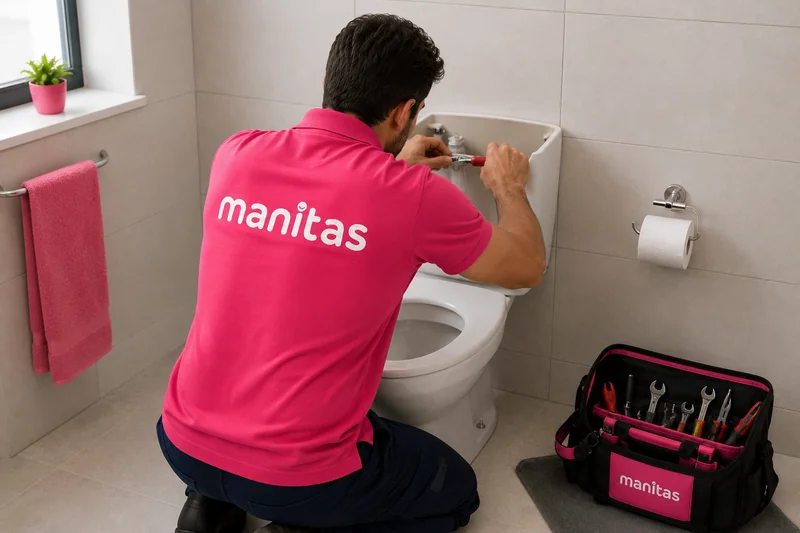
What water hammer actually is
Water hammer is the technical name for that sharp bang, sometimes like a blow from a hammer, heard in the pipework just as a tap or valve is closed quickly. Water travelling under pressure through the pipe stops dead, and the energy of that movement, with nowhere to go, travels as a pressure wave that strikes the pipe walls and, in older installations, the clips and fixings holding it to the wall.
Why it happens more in some properties than others
High supply pressure
The higher the water pressure in the installation, the more energy has to be dissipated when the flow stops abruptly, and the harder the bang. In areas with high mains pressure the effect is far more noticeable than in installations with pressure regulated down.
Pipework poorly fixed to the wall
When the clips holding the pipe are loose, worn or simply missing along a stretch, the pipe vibrates freely against the wall or nearby elements, amplifying the original bang instead of absorbing it.
Taps and valves that close very fast
Certain modern tap designs, particularly quick-closing mixer taps, stop the flow far more abruptly than a traditional screw-down tap, producing noticeable water hammer with every use.
No air chambers or arrestors
Well-designed installations include small air chambers or dedicated arrestors that absorb the pressure wave before it strikes the pipe hard. In older installations these often do not exist, or have lost their air over the years and stopped doing their job.
Appliances with fast-acting valves
Modern washing machines and dishwashers use solenoid valves that cut the water almost instantly once filling is complete, which can produce noticeable water hammer every time the appliance completes a cycle — especially if the installation has no damping element near that connection.
Why it is not worth ignoring
Beyond the nuisance of the noise, water hammer repeated over years can loosen joints, damage valves and, in the most persistent cases, fracture sections of pipe taking that impact constantly. What starts as an annoying noise can end as a leak if it is not corrected in time. In properties with pipework buried in the wall the risk is greater still, because a fracture caused by repeated hammering can go months undetected until a damp patch appears or the water bill climbs noticeably. In those cases, where a leak is suspected alongside the noise, it is worth combining a pressure check with a meter test before deciding whether any wall needs opening to confirm it.
Solutions by cause
| Cause | Usual solution |
|---|---|
| Mains pressure too high | Fit or adjust a pressure reducer |
| Loose or poorly fixed pipework | Check and replace the pipe clips |
| Taps that close very abruptly | Fit water hammer arrestors at the outlet |
| Air chambers that have lost their air | Purge or reinstate the air chambers |
What you can check yourself
Before calling a plumber, establish whether the noise happens only when closing one particular tap or across the whole installation. If it is a single point, visually checking whether the nearest exposed pipe is firmly clipped to the wall can resolve it with no major work. If the noise repeats throughout the house every time any tap is closed, the origin is more likely the overall pressure of the installation, and that calls for a professional check with a pressure gauge to measure the real figure. In properties over several floors, or in blocks of several storeys, the bang is also typically stronger on the lower floors, where the accumulated pressure of the whole water column is greater than higher up — so the floor level is part of the diagnosis too.
When to fit a pressure reducer
If a gauge test confirms that incoming pressure exceeds the levels recommended for domestic installations, fitting a pressure reducer at the property's main inlet not only reduces water hammer but extends the life of every tap and water-using appliance, all of which wear less under stable, in-range pressure. The reducer is normally fitted just after the main meter, and once set to the recommended pressure it rarely needs frequent maintenance beyond an occasional check that it is still operating within range. In residents' associations where several neighbours share the same supply, fitting the reducer at the building's inlet rather than property by property is usually the more efficient solution and avoids duplicating the cost between owners. Before committing to that, it is worth checking with the property manager whether any neighbour has already fitted an individual reducer, so the expense is not duplicated and the pressure does not end up uneven between flats.
If your property has recurring water hammer, Manitas covers the whole Vega Baja and quotes free of charge to diagnose the cause and apply the right fix.