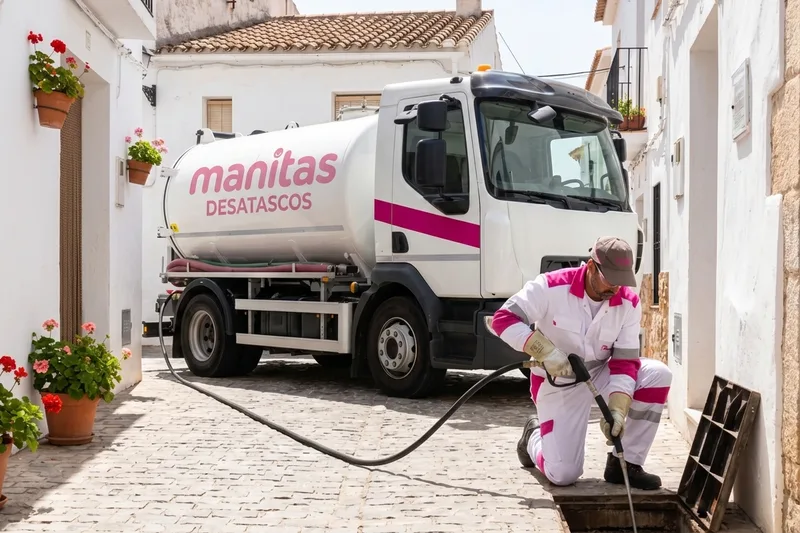

Why drain smells spike in summer
Every year, as soon as the heat arrives, the same complaint comes back from properties across the Vega Baja: an unpleasant smell rising from the bathroom, the kitchen or a garden chamber that was barely noticeable the rest of the year. It is not a coincidence. Heat speeds up the decomposition of organic matter held in pipes and traps, and the same temperature makes the resulting gases spread through the air far more readily rather than staying contained as they do in cooler months. On top of that, July and August are the busiest months on this coast, with properties that have been shut up for much of the year suddenly opening to receive family or a holiday let.
The most common cause, and the least serious: a dried-out trap
Before assuming a fault, rule out the most frequent cause — which is also the easiest to fix. Every trap, whether under a shower tray, a floor gully or a rarely used toilet, permanently holds a small volume of water that acts as a seal and stops sewer gases rising into the property. When a room or a guest bathroom goes unused for weeks, that water gradually evaporates and the trap dries out, letting the smell through unimpeded.
How to check and fix it
The test is simple: pour half a litre of water straight down every floor gully and shower tray that has not been used for a while, including those in guest rooms and secondary bathrooms. If the smell clears within minutes, that was exactly the problem, and repeating the gesture every two or three weeks while the property is lightly used is enough to keep it away.
When it is not the trap: other common causes
Sediment and grease built up in kitchen pipework
In heavily used kitchens, the grease coating the pipe wall decomposes in the heat and produces a different smell from sewer gas — more rancid, and concentrated at the sink. Bicarbonate of soda and vinegar usually relieve it, though if it persists the run deserves a closer look.
A septic tank approaching saturation
In villas and urbanisations with no connection to the municipal network, a smell that appears near the garden or the access cover, especially on very hot days, is usually the first warning that the septic tank is nearing capacity and an emptying should be scheduled before the problem grows.
External chambers holding accumulated waste
Chambers in yards and gardens, particularly in properties closed for much of the year, collect sediment and organic matter that decomposes far faster in summer. Preventive maintenance before high season stops the smell becoming the first unpleasant surprise on arrival.
Inadequate or blocked ventilation
Every drainage installation has a vent, normally emerging through the roof, that lets gases disperse outside instead of finding their way out through the weakest trap in the property. If that vent is blocked — by an insect or bird nest, for instance — the smell can appear with no other apparent cause.
Identifying the source from where you smell it
- Smell localised at a single floor gully or little-used shower: almost always a dried-out trap.
- Smell concentrated at the kitchen sink: grease built up in the pipework.
- Smell in the garden, near an access cover: septic tank or chamber.
- Smell appearing throughout the house at once, with no clear source: check the installation's ventilation.
Preparing the property before summer arrives
For properties that stay closed much of the year, whether because the owners live outside Spain or because it is a second home, a quick check before the busy season pays off: refill every trap with water, visually inspect the external chambers, and if the property has a septic tank, confirm when it was last emptied. A few minutes of checking stops the first day of the holiday turning into an emergency call. The same applies to residents' associations with low-traffic communal areas, such as plant rooms or the toilet by the pool, where a dried-out trap is even more common than in a private home.
When the smell signals a genuine fault rather than neglect
If after refilling every trap, checking the kitchen and inspecting the garden the smell is still there, or returns within days at the same intensity, stop assuming it is minor. A persistent smell can point to a partial fracture in a buried section of pipe, a ventilation problem that cleaning the external vent will not resolve on its own, or a septic tank already past saturation and needing more than a routine emptying. In these cases, persisting with household products only delays a diagnosis that gets simpler the sooner it is made.
If the smell persists after checking traps and chambers, or you cannot locate the source, Manitas covers the whole Vega Baja and quotes free of charge to diagnose the cause.