Why October and not June
In June everyone discovers at once that their unit is not cooling, and every technician on the coast is booked. Servicing in October is not just more convenient: it is more useful, because the unit has just worked for four months and anything failing is fresh.
A unit that struggled in August will say so at an October service. The same unit checked in June, after eight months standing still, hides its faults better.
What a summer leaves inside
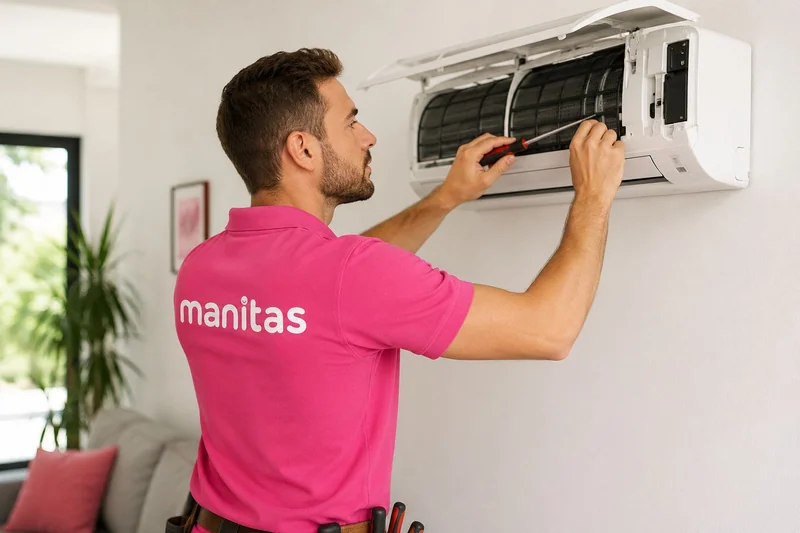
The filter loads with dust, and around here with Saharan dust, which is fine and sticks. The indoor coil builds up a layer that cuts heat exchange and makes the unit work harder to deliver less.
The condensate tray and its drain collect damp dirt, and that is where the stale smell on next year's first start-up is born.
Salt on the front line
In Muchavista, Cabo Roig, Punta Prima or La Mata, sea air deposits salt on the outdoor coil. Corrosion advances slowly and performance drops a little each summer, until one day the unit no longer delivers what it used to.
An annual wash of the outdoor coil with the right product transforms the working life of the unit. It is the difference between eight years and fifteen.
Switching it off properly
Before leaving it idle until spring, run it in fan mode for a while to dry the inside. A unit switched off damp and left that way for six months is a unit that smells on return.
And if it has a heating function, do not shut it away: use it on the cool days in January. A heat pump performs far better than an electric radiator and the hour of comfort costs you less.
Community rules, while there is no hurry
If you are thinking of changing the unit or moving the outdoor part, autumn is the time to read the community statutes and ask the administrator. In June, hot and in a hurry, that conversation gets skipped and ends in a forced removal.
Checking now costs one email.